Why Festival and Stadium Networks Go Dark When Crowds Gather
Cellular networks stall at packed events when signaling channels collapse. Discover how peer-to-peer mesh networking turns attendee smartphones into an autonomous communications web that keeps crowds connected without relying on towers.
3 min readConnor Neistadt
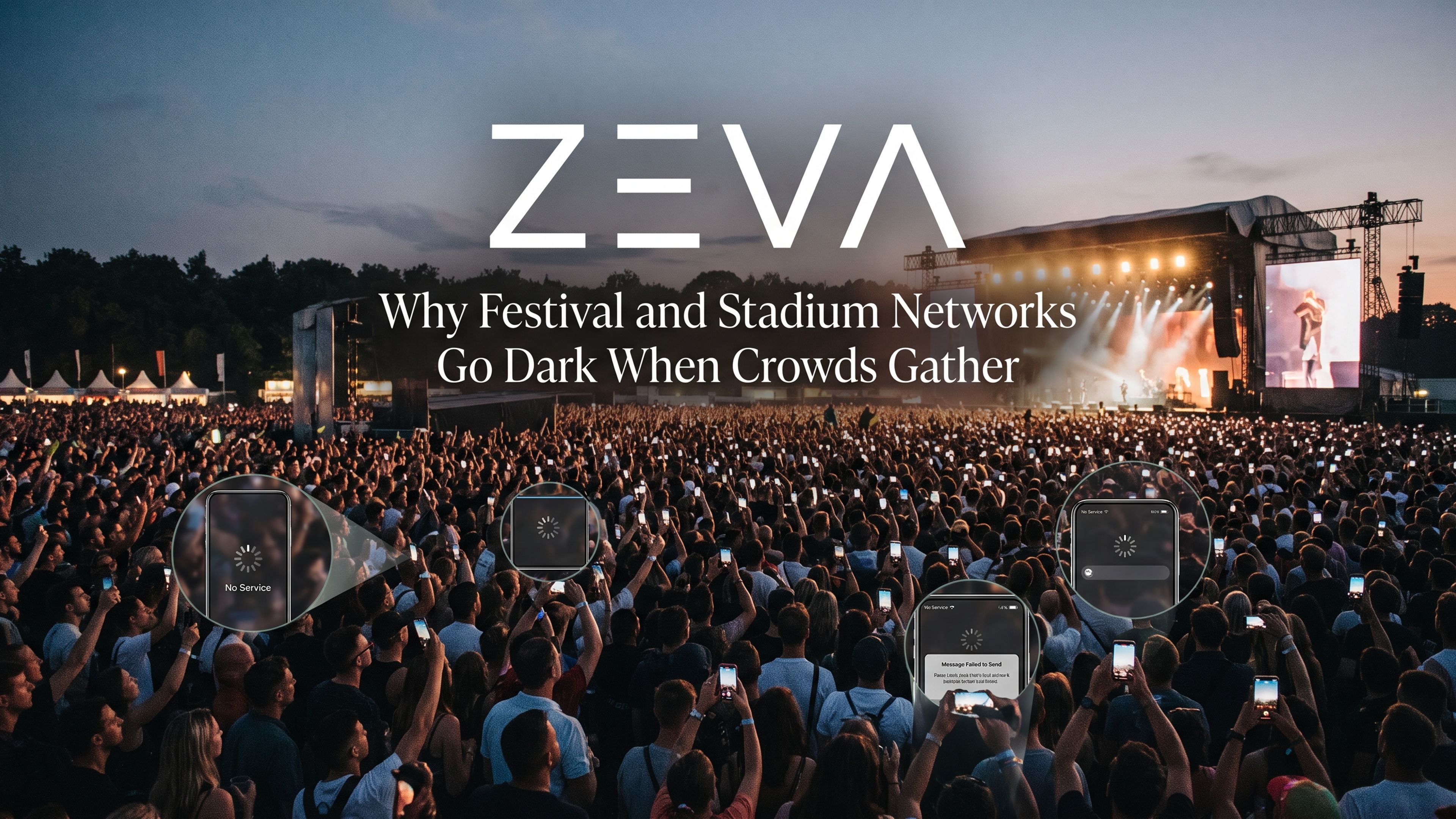
Every event director knows the precise moment when connectivity fails. It does not happen gradually across the afternoon, but rather strikes the exact second the headliner steps onto the stage or when the final whistle blows. Tens of thousands of attendees pull out their phones to text their friends or share a video, only to discover that their messages refuse to send. Even though their screens clearly display full bars of cellular reception, nothing moves, leaving guests frustrated and operational staff cut off from one another.
Most people assume the problem comes down to raw bandwidth, imagining a crowded highway where there are simply too many cars trying to drive down the same road. In reality, the breakdown occurs much earlier at the tollbooth itself. Cellular towers split their duties between a bearer pathway, which carries the actual photos and messages, and a control channel, which manages access requests. Every time a smartphone refreshes an application in the background, checks a map, or wakes up from sleep mode, it knocks on the door of that control channel to ask for clearance. When fifty thousand devices attempt to knock on that door simultaneously, the tower becomes paralyzed by the sheer volume of incoming requests, which means the data pathway remains practically empty while everyone is stuck waiting outside.
The traditional response from venue operators has always been to bring in more hardware by renting mobile cellular trucks and setting up temporary antenna arrays across the grounds. While this equipment can help extend baseline coverage into remote fields, it quickly runs into the unforgiving laws of radio physics. Because radio spectrum is strictly finite, packing too many high powered transmitters into a single stadium bowl or concert meadow causes the signals to collide and interfere with each other. Radio engineers are then forced to reduce the broadcast power of each individual antenna so they do not cancel out their neighbors, which means that doubling the hardware budget rarely doubles actual capacity.
The deeper flaw lies in how modern networks route messages between people who are standing right next to each other. When an attendee tries to text a friend standing by a food vendor thirty feet away, that digital message does not simply leap across the open grass. Instead, it must travel from the phone up to an overloaded local tower, pass through miles of optical fiber to reach a central telecom facility in another city, and then travel all the way back down to the same crowded tower before finally reaching the recipient. Routing local conversations through nationwide infrastructure makes very little sense in crowded environments, especially when every device in that crowd already carries the radios needed to communicate directly.
Mesh networking solves this operational nightmare by turning every participating phone into a miniature relay station that helps carry the load. By allowing devices to connect locally through built in radios such as Bluetooth and local wireless protocols, software platforms like Zeva create an autonomous network that functions independently of external cell towers. When someone sends an update or an alert, that data can hop securely from device to device across the field until it reaches its intended destination. Because the system operates entirely within the footprint of the event, local conversations never have to compete for access to an overloaded telecom tower.
Beyond improving the guest experience, this decentralized architecture fundamentally changes how venues handle safety and risk management. During severe weather evacuations, medical emergencies, or sudden crowd surges, waiting for an overloaded cellular network to clear a queue of outgoing text alerts is a liability that no responsible organizer can afford. When an emergency notification is broadcast through a local mesh, the message propagates outward across thousands of screens within seconds, ensuring that medical teams, security personnel, and attendees receive life safety instructions without relying on third party internet providers.
Live events will only become more crowded and digitally demanding as the years progress, but solving connectivity does not require spending fortunes on heavy industrial antennas that struggle under their own weight. By empowering the devices already carried by your crowd to communicate directly with one another, organizers can build an event environment where people stay safe and connected no matter how dense the crowd becomes. If your team is preparing for an upcoming festival, stadium season, or road race, connecting with the engineers at Zeva offers a straightforward path toward reliable communications that never leave your guests stranded in the dark.